


This article will be removed within the next 24 hours.
I INEVO We have experimented with AI (artificial intelligence) for more than one year.
A while ago, a case study published where we used AI to improve existing content.
The AI experiment led to a 32% increase in traffic, and when we shared the case study at LinkedIn, the article shown more than 2,Two million times.
INEVO works primarily with e-commerce companies, but we also collaborate with a handful of B2B SaaS companies, where we run AI experiments as part of a content strategySo let's say that this is the same thing as that.
The experiments below are "live", and when we have enough results, we share the results in our weekly newsletter, EFFECT.
Here are 3 experiments that we run right now using ChatGPT and Surfer SEO.
(Included prompts and preliminary results).
1. Use of AI to update outdated statistics
It is time-consuming to update old statistics in articles, but it is necessary to keep the content up to date (and relevant).
To update old statistics, you need to use Google to find new and updated research, make sure that the statistics are relevant and write a new text that can be used in your articles. The work usually takes 3-4 hours.
But what if AI can help us with this process and update outdated statistics?
Here are the promps we used to test it out - and the preliminary results.
Here's the prompt we used:
Read the text of the URL below and suggest three new and unique data points that you recommend I include: URL
Be specific and mark where in text. Suggest new texts and specify the sources from which you have retrieved the information. Only use research published after 2022.
Use bulleted lists to format your response:
- Position: sit the original sentence or paragraph in its entirety here.
- Suggest new text: Suggest text and reference to the new data
- Source: Specify the specific URL where the data is available
And here's an example of what the AI-generated answer looks like:

I can easily cut and paste the new numbers into the articles so they get updated. I don't have to edit anything. So far, we have used the prompt on nine articles and reduced the time it takes to update research from 3-4 hours to 4 minutes per article.
Traffic has increased by 25-30% for the articles we updated.
Here's an example of the results for one of the articles we updated.

2. Use of AI to generate extra contents
If your goal is to increase organic traffic, one of the tactics is to create more content.
For example, if you want to attract CRM buyers, you have to write a lot about CRM.
The more (and better) articles you have on a specific topic, the more "Authority" has your website in terms of how Google looks on your website.
Let's say you have an article about "What's CRM?"
To support this article, you can rewrite:
- The Benefits of CRM
- CRM Challenges
- Best CRM Policy
- Best CRM software
- ...and so on.
This will help you get more traffic for CRM-related searches.
But... If you only have one writer in your team, it will take several months to finish 6-8 articles!
Can AI help us in this process of creating more content?
We have an article that rank high on page 1 for a customer, but we don't have many related articles on that topic. We had to produce more on this theme.
Using Surfer SEO, an AI content platform, we created six new articles. Every article took less than 45 minutes from the time we entered a keyword until the content was published.
Instead of taking 2-3 months, the entire project took one day.
It went fast!
Here's the exact process:
- Sign up for SurferSEO
- Enter a keyword
- Review Disposition and Approval
- Review the first draft
- Copy and Paste into CMS
- Publish the article
Within two weeks, the article we wanted to rank higher, moved to position 2 and has received 19% more clicks from Google (approx. 500 clicks).
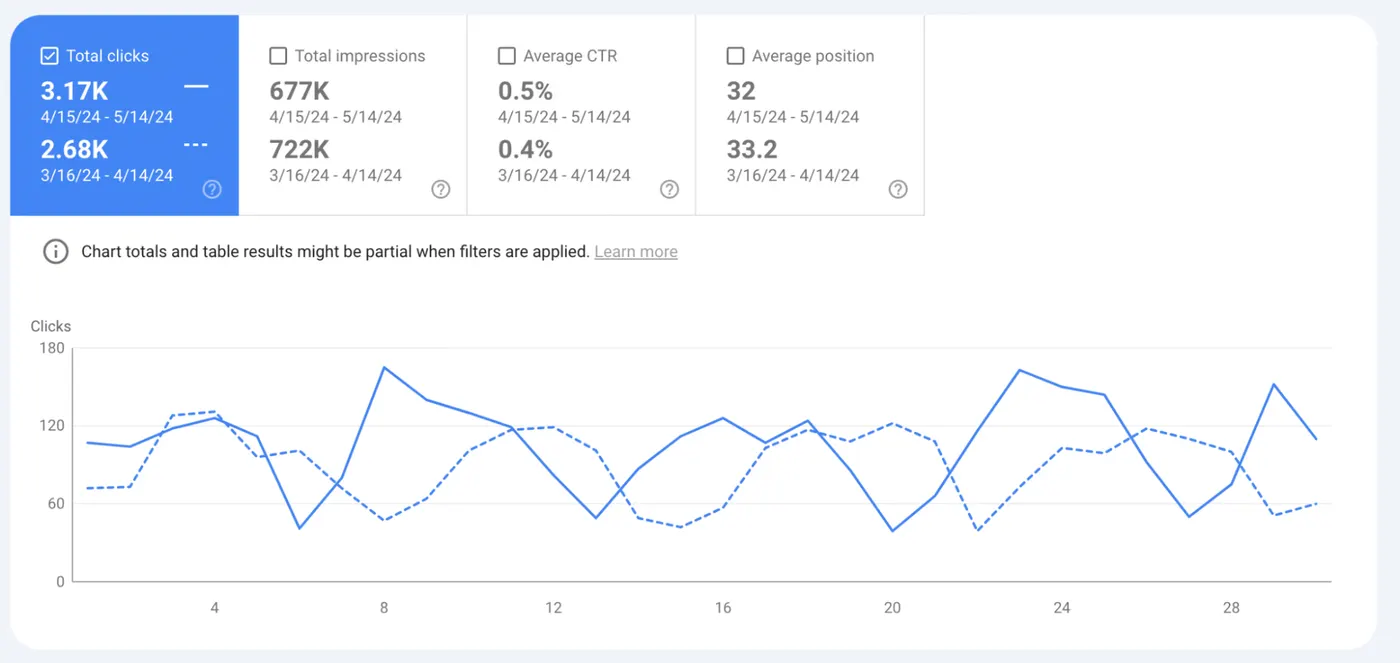
But here it's even more interesting:
The AI generated content also gives traffic.
On Only 2 weeks the six AI articles have generated 153 clicks on the website.
Three. Use of AI to improve conversion
To attract traffic is one thing.
The conversion of visitors is different.
Most B2B market drivers want to convert visitors to potential customers by adding a CTA at the bottom of an article. But it's usually just one CTA.
Would more CTAs improve the conversion rate? Maybe.
Can AI support this process and help us convert multiple readers? Let's figure out.
This is our last experiment.
Here's the prompt:
Read the text of the URL below and suggest 3 new CTAs to order a free demo: URL
Use points to format your response:
- Position: Cite the original sentence or paragraph where CTA is to be added
- Proposal for a new text: Suggest text to CTA
And here's an example of what the generated answer looks like:
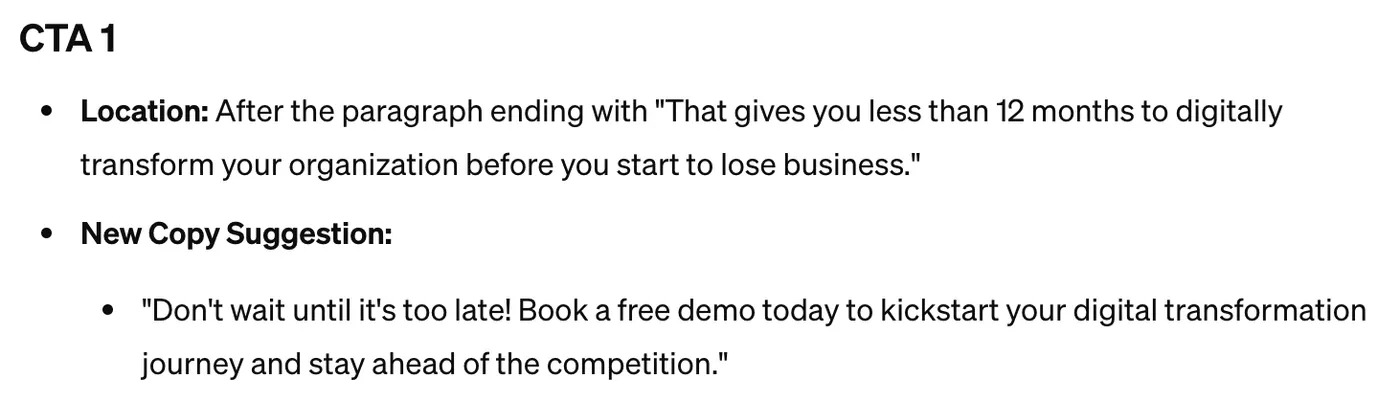
Simple, right?
We started this experiment last week, so we're still collecting the results...
...but the preliminary resulates are exciting.
Although the site visits have been slowed down, the exposure on the side and the number of side clicks increased!

We are now going to run this experiment on several pages to see how it can affect the conversion rate on the entire website.
(This will be a fun experiment to follow).
What is your AI strategy for B2B marketing?
There is no right or wrong way to use AI right now.
We're still at the experiment stage.
And that's important, because that means you should also experiment.
If you have not yet put AI into your marketing strategy, or if you need help to come up with experiments, contact us. We're happy to discuss the above experiments in more detail, and together we can suggest new experiments that you can run.
It's an exciting time to work with AI. Don't let the opportunity go away from you.